ZoneSheet
Turn zoning and permit PDFs into cited data sheets, side by side.


About
ZoneSheet reads the zoning or permit PDF you already have and returns a clean, structured data sheet: setbacks, max building height, floor area ratio, lot coverage, allowed uses, parking minimums, and key fees. Every value is cited to a verbatim snippet from the source document, so a reviewer can check it in seconds.
Because it reads the document rather than a preloaded database, any US jurisdiction whose ordinance is a PDF with a text layer works on day one, including whole ordinances of several hundred pages. There is no question of whether your city is covered.
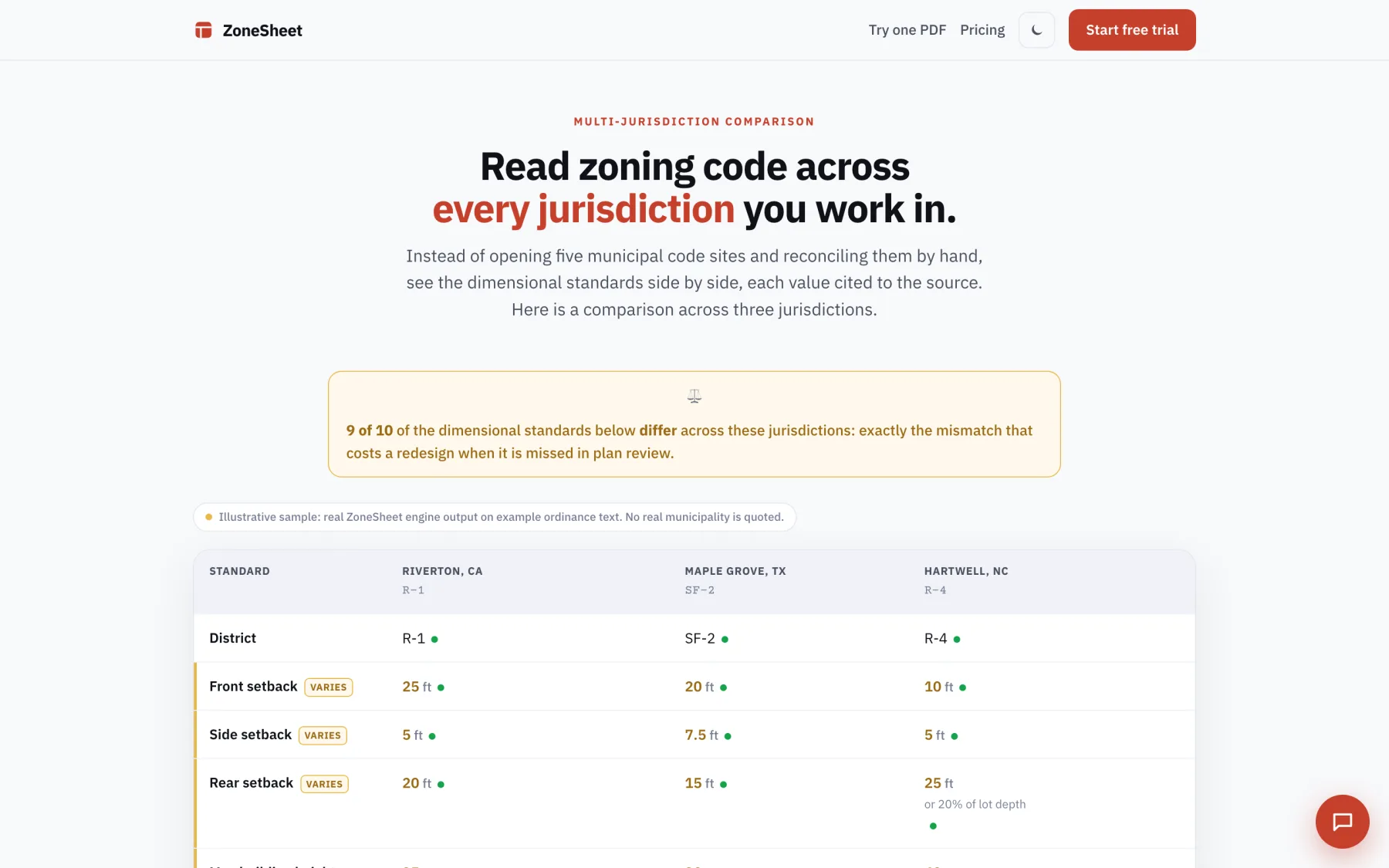
Architecture, engineering, and construction teams and permit teams juggle different standards in every municipality. ZoneSheet lays each jurisdiction's numbers next to the others and highlights the rows where they differ, then Portfolio Mode ranks two to 10 parcels by buildability and names the binding constraint for each site.
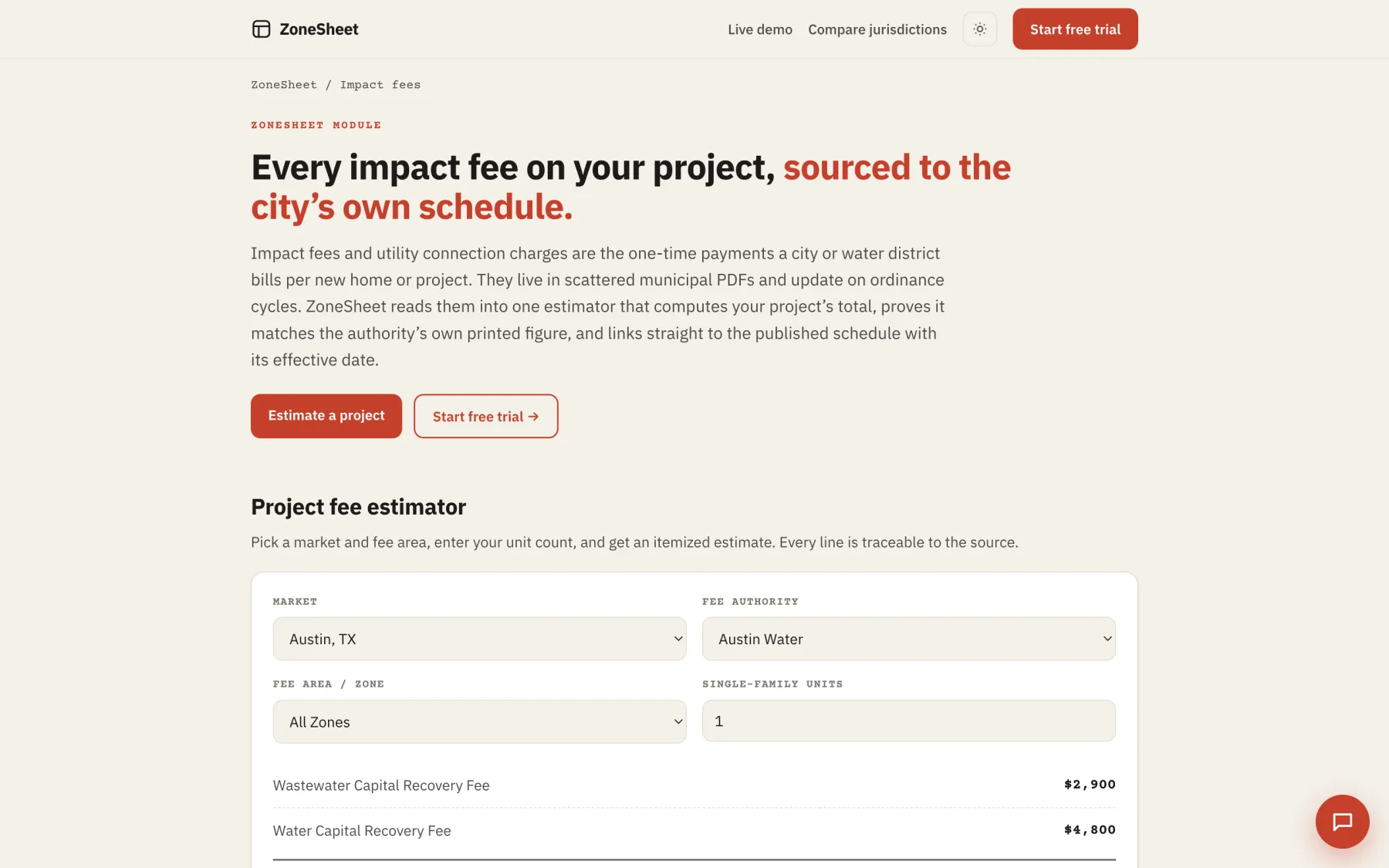
Ask ZoneSheet a question about your sheet in plain language, and export every run as CSV or JSON. The Impact Fees module estimates the one-time impact and utility-connection fees a city bills per new home, reconciled to the authority's own printed total.
Read the PDF you already have
Drop a zoning PDF from any US jurisdiction and get a cited datasheet in about 30 seconds. Each value links back to the line it came from.
Compare jurisdictions side by side
Lay the standards of several municipalities next to each other, with the rows that differ highlighted, so a mismatch shows up before plan check does.
Portfolio Mode
Rank two to 10 parcels against your goal and see the binding constraint named for each site, reasoned only over values that are already cited.
Fees and allowed uses
Fee schedules and permitted-use tables are extracted alongside the dimensional standards, and a fee or use appears only when the source text states it.
Ask ZoneSheet
Chat over your sheet: whether a district allows three-story multifamily by right, and what the binding constraint is for buildable square footage.
Impact fees, sourced to the city
The estimator itemizes impact and utility-connection fees for your project, proves the sum matches the authority's printed total, and links the published schedule with its effective date.